It's one thing for the Canary Coalition (CC) to have wasted time waiting for Onalia Bueno to be their candidate, and quite another for a left-wing or agro-progressive municipalist front to take over the CC franchise in Mogán, in southern Gran Canaria. The moneyed sector is counting on an alliance between CC and Prica, but is appalled at the prospect of a party that defends the ecotax, like the current outgoing CC mayor, taking control of the Canarian nationalist party.
It suffices to say that the mayor, now under the PP's influence, has lost the legal battle against the Las Palmas hotel association over the implementation of the ecotax. Within CC, they point out that a significant number of votes need to be mobilized and that Prica's presence is nullified if they don't secure the support of members who don't back Bueno in his move to the PP. For example, they don't know Prica's opinion on the cement plant with Brazilian and Asturian capital located on the border with Tirajana. What CC is risking in the tourist municipality of Mogán is holding the key to governing the Canary Islands. While there are few votes, many companies operating in Mogán, headquartered in Las Palmas and San Bartolomé de Tirajana, wield considerable influence in business organizations that sympathize with CC's platform.
The news, first reported by Maspalomas24H, that CC wants to reshape its local alliances has generated unease within the Las Palmas branch based in Agüimes for one reason: Prica had hoped to control CC in Mogán after Bueno's departure. But CC has a different perspective: While agreements are fine, they don't mean dismantling the work that has been done since 2023. There are highly valuable individuals whose sacrifices "we will not tolerate for an electoral project that aims to add, not subtract," sources within the party told Maspalomas24H. In southern Gran Canaria, CC hopes to gain electoral advantage from two things: the political stability of Maspalomas and expanding its presence in Mogán.
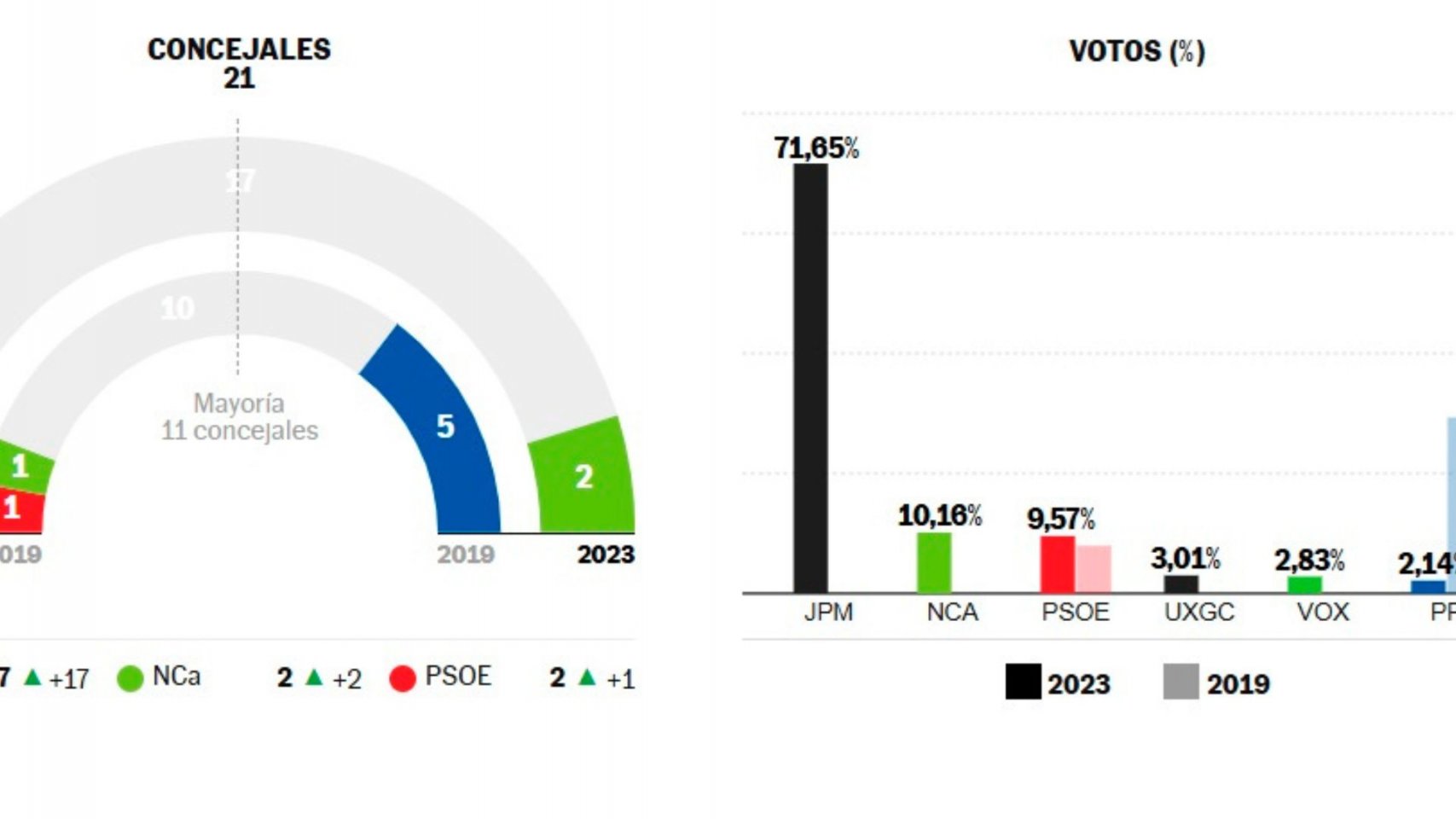
The breakdown of the vote count shows that the mayor's party garnered 5.188 valid votes, representing a resounding 71,65% of the total votes cast in the district. The May 28th election saw a 60,92% voter turnout, translating to 7.306 votes cast compared to 4.685 abstentions, representing 39,07% of those eligible to decide the future of the city council.
The strategic enclave on the southern coast of Gran Canaria created a scenario of unparalleled concentration of power in the local elections, in contemporary island municipalism, where the instrumental platform Together for Mogán (JPM), led by Onalia Bueno, crushed its competitors by obtaining an overwhelming absolute majority of 17 councilors out of the total of 21 councilors that make up the municipal corporation.
Behind the electoral steamroller of Juntos por Mogán, the institutional landscape fragmented the remaining seats on the local council between two parties that managed to surpass the legal threshold for representation. Nueva Canarias-Frente Amplio Canarista (NC-FAC) emerged as the main opposition force, retaining two council seats after garnering 736 votes, equivalent to 10,16% of the total. Meanwhile, the Partido Socialista Obrero Español (PSOE) tied for representation, also securing two seats with 693 votes, representing 9,57% of the total.
The rest of the political parties running were completely excluded from the council, failing to reach the minimum five percent threshold required by electoral regulations. The local party Unidos por Gran Canaria (UXGC) narrowly missed entering the council, garnering 218 votes (3,01%), followed closely by Vox, which obtained 205 votes (2,83%). The People's Party (PP), which in previous terms held greater sway in the southern region, suffered a historic collapse in the municipality, plummeting to 155 votes, a mere 2,14% of the total, and no institutional representation. These results stand in stark contrast to the 2019 election, when Ciuca—the mayor's previous party—sweeped the elections with 4.334 votes and 48,9% of the total.