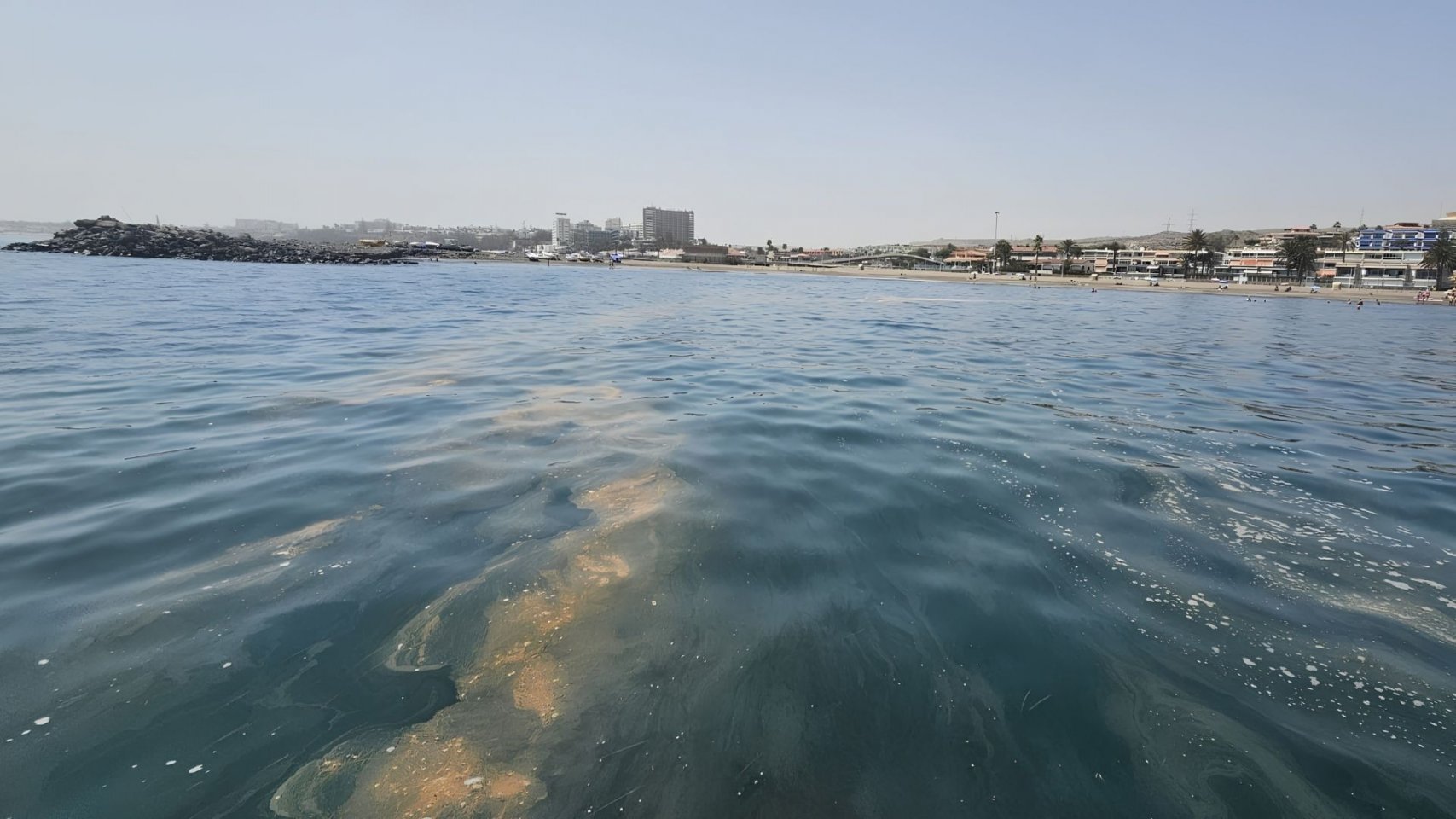
The southern coast of Gran Canaria has recently experienced episodes of biological accumulation, raising public concern along the San Bartolomé de Tirajana coastline. Despite public concern over the presence of patches and foam in the water, analyses and technical assessments have definitively ruled out any connection to spills, inadequate sanitation, or contamination from industrial or urban waste.
The phenomenon is strictly due to the appearance and proliferation of the diatom microalga Attheya Armatus. After examining samples collected along the coast, the Canary Islands Institute of Marine Sciences has identified these episodes as completely harmless accumulations, thus allaying fears about a possible environmental or toxicological risk in the bathing areas of the tourist municipality.
Experts have clarified that these algal blooms are part of the natural dynamics of the marine environment, driven by oceanographic and climatic factors specific to the Atlantic waters surrounding the archipelago. As this is a phytoplankton organism with no significant toxicity for humans, the presence of the diatom poses no danger to human health, allowing for the continuation of normal recreational and tourist use of the beaches in southern Gran Canaria, contrary to the initial unfounded alarm.
In the Canary Islands, the predominant species is Attheya armatus, which has been described on sandy beaches worldwide for many decades, according to Leopoldo O'Shanahan Roca, a biologist with a doctorate in Marine Sciences. He has been a scientific collaborator at the Institute of Marine Sciences in Barcelona and Head of Section in the Bacteriology Laboratory of the Canary Islands Institute of Marine Sciences.
On some beaches, we can sometimes find patches of a brownish-green hue that at first glance resemble grease or some kind of spill washed ashore. These are actually microalgae that live among the grains of sand and are therefore called "epipsamic," from the Greek epi- (upon) and psammo (sand). Diatoms, one of the most abundant and ecologically important groups of phytoplankton, are usually dominant among these algae, as their high productivity forms the basis for the functioning of the marine ecosystem. On fine-grained beaches with a gentle slope, these patches of diatoms can be observed for a few days at different times of the year, tinting the surf and the damp sand.